Vaccine Hesitancy
Vaccine hesitancy is defined as the refusal or delay of acceptance of vaccines despite the availability of vaccines services (MacDonald, N.E., & SAGE Working Group on Vaccine Hesitancy, 2015). It is a complex issue that varies across time, place, context, and specific vaccines. It is influenced by factors such as complacency, convenience, and confidence (MacDonald, N.D., & SAGE Working Group on Vaccine Hesitancy, 2015). The following adapted image from the World Health Organization’s Determinants of Vaccine Hesitancy Matrix describes contextual, individual and group, and vaccine-specific issues related to vaccine hesitancy (MacDonald, N.D., & SAGE Working Group on Vaccine Hesitancy, 2015).
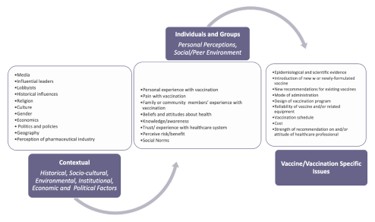
Vaccine hesitancy is an issue of major public health concern as it not only has implications on individuals, but also societies. Vaccine hesitancy and refusal is correlated with increased risk of vaccine-preventable diseases and may have effects on population health given its effect on herd immunity (John Hopkins, 2021). Vaccine hesitancy during the Covid-19 Pandemic has contributed to reduced vaccine uptake and demonstrated profound implications for economic progress, governmental trust, health outcomes, and social cohesion (Organization for Economic Co-Operation and Development, n.d.).
Public health professionals are essential in addressing vaccine hesitancy and building trust. Open communication, transparency, and empathy are essential in building trust and vaccine confidence (Sauer, M., & Limaye, R., 2021). A systematic literature review on interventions to address vaccine hesitancy found that no one specific strategy was deemed to be solely effective; instead, the most successful interventions were multi-component in nature, provided a variety of media touchpoints, incorporated dialogue, employed a trusted messenger, and were tailored to a specific population to address their experiences and specific concerns (Olson et al., 2020). John Hopkins Coronavirus Resource Center (Sauer, M., & Limaye, R., 2021) describes evidence-based approaches to build confidence and demand:
- Limit correcting misperceptions
- Communicate in a way that builds confidence in taking effective action against a perceived risk for disease
- Use language that assumes a person will vaccinate
- Utilize motivational interviewing to work towards a common goal
- Practice empathy to build trust
- Tailor communication to meet the specific beliefs, attitudes, and experiences of an individual
- Be transparent and communicate often
It is important to note there are several factors that influence decision to vaccinate. Factors include individual attitudes that may arise from a particular identity, perceived need to conform to social norms, sense of identity and belonging within a group that shares religious, philosophical or educational views, culture and cultural norms, habits, and structural barriers, such as access, inconvenience, and cost (WHO, 2013, p. 20).

This communication “cheat sheet” provides tips on how to talk about vaccinations, including resources specific to the Covid-19 vaccine (de Beaumont Foundation, 2021).

Read Responding to Parents: Resources & Information.
This website provides science-based materials from a variety of reputable organizations to discuss vaccine related questions with confidence (immunize.org, 2025).
Conspiracy Theories in Public Health and Vaccines
Conspiracy theories in the context of public health may be described as “narratives that can enable and accentuate distrust toward health professionals and authorities … that can lead to violent radicalization” (Leonard & Philippe, 2021, p. 1). Conspiracy theories specific to vaccines (e.g., Covid-19 vaccines) may result in vaccine hesitancy, governmental distrust and lower likelihood to engage in health protective behaviors, all which pose a significant threat to public health initiatives (Juanchich, 2021).
The OPTIONAL three-part video series Conspiracy Theories in Public Health and Vaccines (Sethi, 2021) will provide an overview of conspiracy theories in public health. The accompanying readings provide prerequisite background knowledge and are discussed within the videos.
The strategies offered in the video series provide guidance on how public health professionals can contribute to the solution rather than the problem. However, there is no single method proven to work for changing the minds of individuals who believe in conspiracies theories. Moreover, conspiracy theorists are not homogeneous. That is to say, an individual who believes in some conspiracies may not believe in others. Therefore, an intervention that conceivably could “work” on one individual may not necessarily “work” on others.
Optional Part I:

Watch Part I of Conspiracy Theories in Public Health and Vaccines (Sethi, 2021) (5 min).
This video will explore examples of popular conspiracies and factors that contribute to their spread, including medical conspiracies, and those specific to Covid-19. It will also provide strategies to strengthen conversational skills with individuals who may have views that differ from your own. To note, it is important to consider that some parents do not think certain diseases exist or are a proximal concern (e.g., pertussis). As such, many of these vaccine-hesitant parents believe they are protecting their children from the perceived harms of repeated shots.
Optional Part II:
This research letter describes a study that sought to identify the extent of “medical conspiracism” in the U.S. public. Their findings suggest medical conspiracies are widely known, endorsed, are predictive of many health behaviors and arise from common attribution processes (Oliver & Wood, 2014).
Watch Part II of Conspiracies in Public Health and Vaccines (27 min).
In this segment, Dr. Sethi discusses the Oliver & Wood article.
Optional Part III:

Listen to Terry Gross’s interview with Historian Michael Willrich on NPR’s Fresh Air: How The “Pox” Epidemic Changed Vaccination Rules (NPR, 2011).
When listening, make note of and formulate some of your thoughts on the following topics in particular:
- Police powers to enforce vaccination programs vs. individuals’ rights to not be vaccinated
- Discrimination during smallpox vaccination in the U.S.
- Public acceptance or resistance of vaccination and mandatory vaccination programs in the pre- and post-9/11 and COVID-19 worlds.
Watch Part III of Conspiracies in Public Health and Vaccines (22 min).
In this last segment, Dr. Sethi discusses the Terry Gross interview with Michael Willrich.